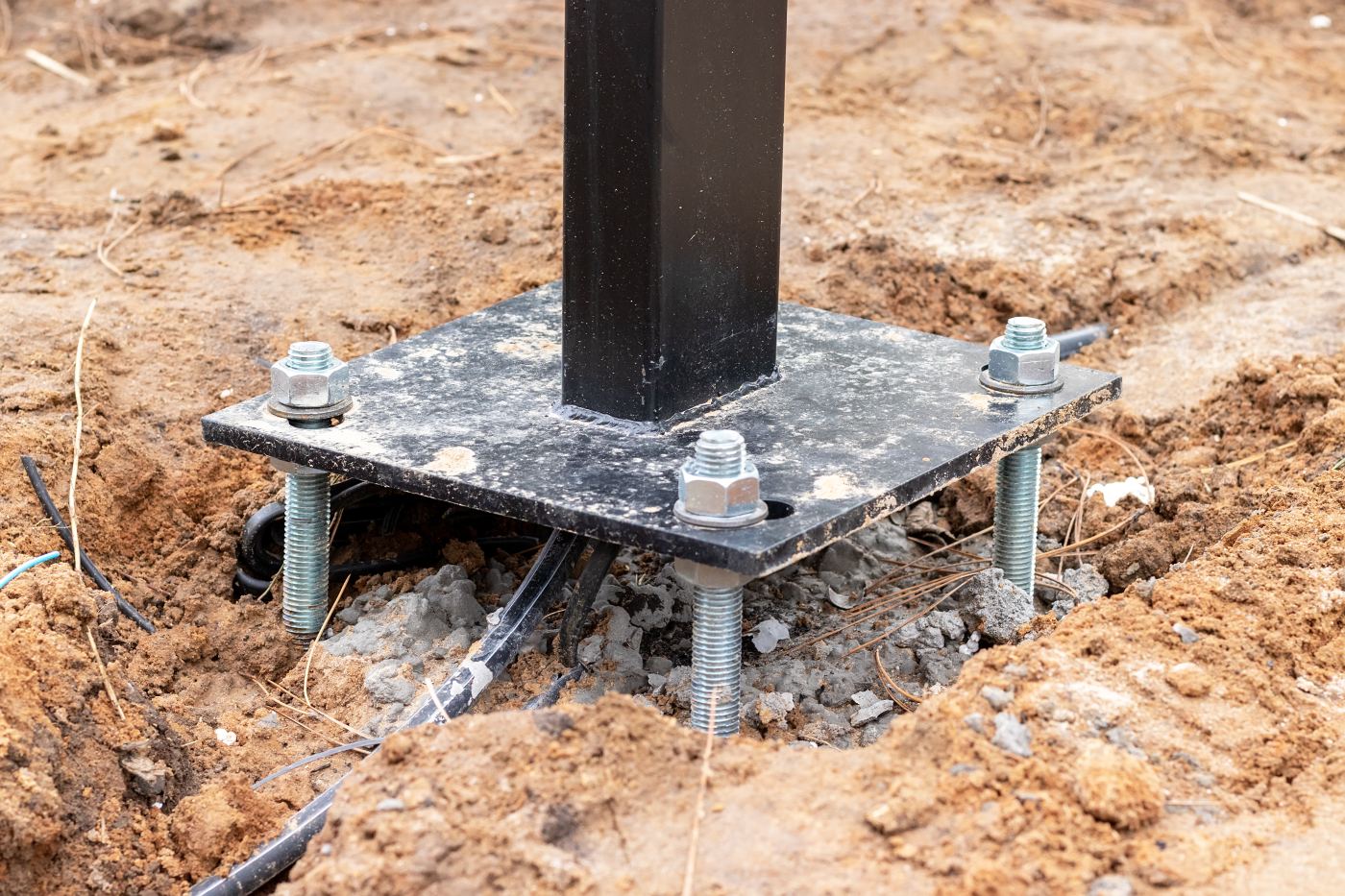
Ground Screws
Ground screws (also known as screw piles or helical piles) represent a dry, deep, or semi-deep foundation system designed to transfer structural loads to the subsoil through a helical mechanical coupling mechanism. Unlike traditional piles, a ground screw does not remove soil but compresses it laterally during advancement, increasing in-situ density and ensuring immediate load-bearing capacity for both compression and tension (uplift).
Origin and History
The technological use of screw foundations dates back to 19th-century engineering, with Alexander Mitchell’s "screw pile" patent (1833), used to stabilize lighthouses and piers on sandy or muddy seabeds. Modern evolution has consolidated in recent decades with the development of high-strength steels and high-torque hydraulic motors, making this system the standard for green building and lightweight structures. Today, they represent the preferred solution for low-impact construction sites, eliminating the need for massive excavations and concrete pours.
Types
The geometry of the screw is selected based on soil stratigraphy and design stresses:
- Single or Multi-Helix Screws: Designed with one or more circular flanges welded to a central shaft; the multi-helix configuration is ideal for low-bearing capacity soils (clays and silts).
- Continuous Spiral Screws: Characterized by a thread that runs along most of the shaft, ensuring distributed lateral friction, optimal for granular or dense soils.
- Rock Screws: Equipped with reinforced tungsten carbide tips or specific geometries designed to crush the stony substrate during driving.
- Extensible Systems: Composed of a lead section and flanged extension modules, allowing for the reach of bearing layers at significant depths (exceeding 10-15 meters).
Symbolism
- The ground screw symbolizes reversible architecture and respect for the ecosystem.
- It represents a "gentle" yet tenacious connection with the earth: unlike concrete foundations, which irreversibly alter the site, the screw integrates into the soil and can be removed without leaving residues.
- It is the emblem of modern efficiency, where rotational force and mechanical precision replace the mass and inertia of traditional materials.
Interesting Facts
- One of the most relevant technical peculiarities is the possibility of immediate loading: once driving is complete, the structure can be mounted instantly without waiting for concrete curing times (typically 28 days).
- A technical curiosity involves monitoring: during installation, the value of the applied torque (Nm) provides indirect and immediate data regarding the soil's bearing capacity.
- Furthermore, in the renewable energy sector, ground screws are the standard system for securing photovoltaic farms, ensuring millimetric precision in the alignment of solar trackers.