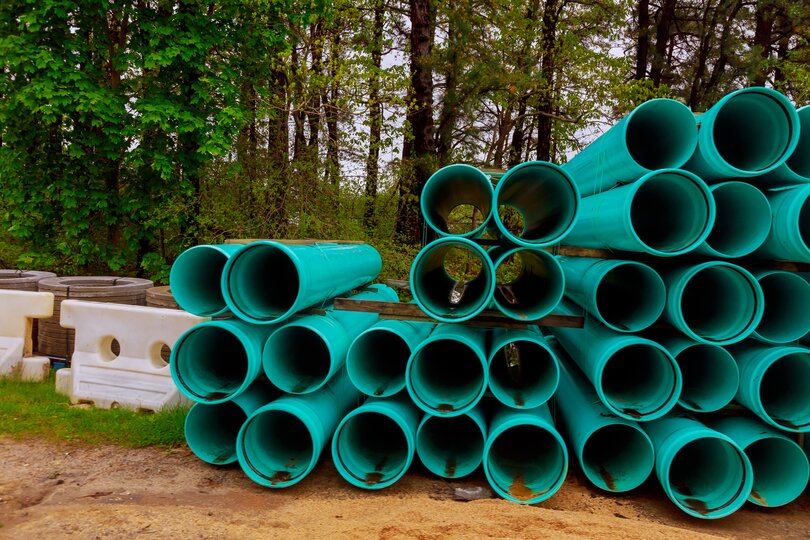
Drainage Pipes
Drainage pipes represent the primary element of underground water collection and conveyance systems. Designed to manage the hydraulic regime of soils and superstructures, these conduits act as regulators of pore water pressure, preventing piping phenomena (internal erosion), soil instability, and the degradation of foundations due to water stagnation.
Origin and History
Drainage engineering has its roots in ancient civilizations (Romans and Egyptians), which used stone channels or porous terracotta tubules for land reclamation. Modern drainage technology underwent a significant shift in the 19th century with the introduction of industrially produced fired clay pipes. However, the true revolution occurred in the 1960s with the advent of synthetic polymers. The transition from concrete and terracotta to PVC (Polyvinyl Chloride) and HDPE (High-Density Polyethylene) allowed for the production of lightweight conduits resistant to electrochemical corrosion and equipped with precision micro-perforations, optimizing the collection capacity per linear meter.
Types
Drainage pipes are distinguished by their wall morphology and hydraulic function:
- Corrugated Perforated Pipes (Drains): These feature a waved external structure (corrugated) that provides high resistance to crushing loads (SN4, SN8) and a series of holes or slots along the circumference. They are designed to "accept" interstitial water from the surrounding soil.
- Double-Wall Pipes (Smooth/Corrugated): Characterized by a corrugated outer wall for mechanical strength and a smooth inner wall to facilitate hydraulic flow, minimizing sediment buildup.
- Geotextile-Coated Pipes: Often supplied with a pre-installed synthetic fiber or coconut husk "sock." This filter prevents fine soil particles (silts and clays) from obstructing the slots, preventing system clogging (colmatage).
- Non-Perforated Collectors: Watertight wall pipes used for the rapid transport of collected water toward final discharge points or attenuation basins, without further dispersion into the ground.
Symbolism
- In infrastructure sites, the drainage pipe symbolizes hydrogeological balance. It represents humanity's ability to govern the invisible forces of the subsoil.
- A well-designed drainage system is the structural "silent insurance": while foundations support the weight, drainage preserves the mechanical characteristics of the soil.
- It is the symbol of prevention against "instability," embodying the transition from passive defense (waterproofing) to the active management of underground water flows.
Interesting Facts
- One of the most relevant innovations is the use of polymers with anti-static and anti-UV additives, alongside the design of "bridge-like" slot geometries that prevent the entry of plant roots.
- Recently, the use of high-performance recycled HDPE pipes has become widespread, promoting the circular economy on-site.
- Furthermore, in modern smart cities, some drainage systems are integrated with piezoelectric sensors that monitor soil saturation levels in real-time, sending telemetric data for the prevention of landslides or urban flooding.