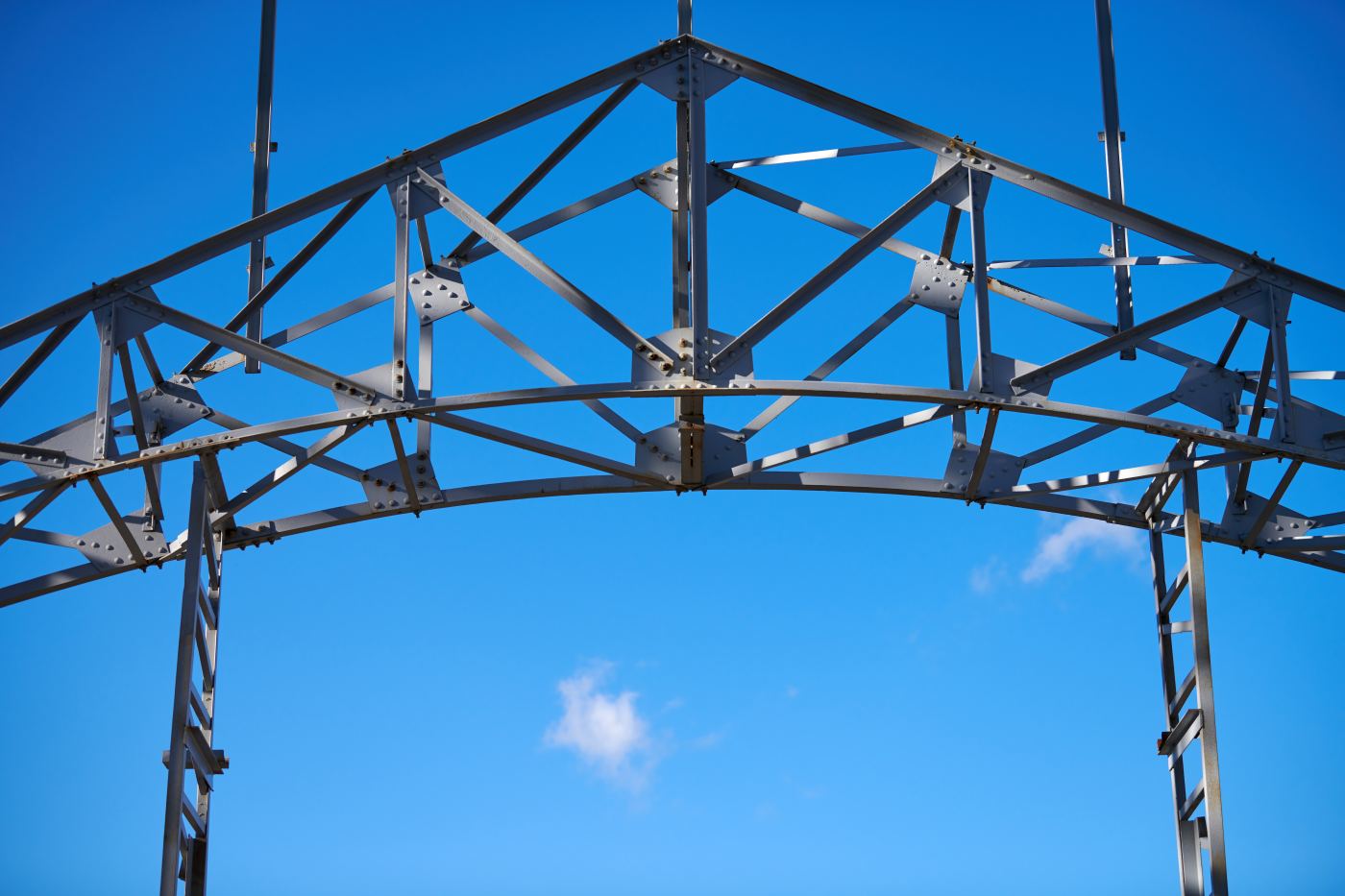
Truss
A truss (or lattice girder) is a structural system composed of an assembly of linear members connected at nodes, configured to form an indeformable mesh of triangles. In terms of structural science, this geometry is the only one that guarantees shape stability under external loads. Its efficiency lies in its ability to transform global bending stresses into pure axial forces (tension and compression) within individual members, minimizing material usage and drastically reducing the structure's...
A truss (or lattice girder) is a structural system composed of an assembly of linear members connected at nodes, configured to form an indeformable mesh of triangles. In terms of structural science, this geometry is the only one that guarantees shape stability under external loads. Its efficiency lies in its ability to transform global bending stresses into pure axial forces (tension and compression) within individual members, minimizing material usage and drastically reducing the structure's self-weight.
Origin and History
While the first timber roof trusses date back to antiquity, the formalization of the modern truss occurred in the 19th century with the rise of railways and the need to span large distances using steel. Pioneers such as Thomas Pratt, Caleb Pratt, and William Howe patented specific configurations that still bear their names. The evolution of bolted and welded steelwork in the 20th century allowed this principle to be extended to monumental works—from railway bridges to large aircraft hangars—making the truss an emblem of industrial engineering aesthetics.
Types
Truss classification is based on the arrangement of chords (longitudinal elements), posts (vertical elements), and diagonals:
- Warren Truss: Characterized by alternating diagonals forming equilateral or isosceles triangles without vertical posts. It is valued for its aesthetic clarity and constructive simplicity.
- Pratt Truss: Features vertical posts and diagonals slanted toward the center (for gravitational loads). In this configuration, diagonals typically act in tension, allowing for thinner sections.
- Howe Truss: The mirror image of the Pratt; diagonals are slanted away from the center and act in compression, while the vertical posts act in tension.
- Mohnié or N-Truss: A robust variant combining vertical posts and parallel diagonals, ideal for heavy and variable loads.
Materials Used in Truss Construction:
- Structural Steel: The material of choice due to its high elastic modulus and specific strength. Profiles used are typically back-to-back angles, hollow sections (tubular), or I-beams.
- Glulam (Glued Laminated Timber): Used in green building for large-span roofs (sports centers, pavilions), where lightness meets charred fire resistance.
- Aluminum and Composites: Employed in mobile structures, event towers, or footbridges in corrosive environments, where low weight facilitates manual assembly.
Symbolism
- The truss symbolizes the optimization of matter. It represents the victory of "void" over "solid": a structure that, despite being composed largely of air, guarantees absolute solidity.
- In architecture, it is the symbol of rationalist rigor and technological transparency, evoking the image of progress challenging gravity through pure geometric logic.
Interesting Facts
- A critical aspect of design concerns the nodes. Theoretically, nodes are considered "perfect hinges," but in constructive reality, they are realized using welded or bolted gusset plates.
- A technical curiosity involves the phenomenon of buckling: since many members act in compression, the designer must pay close attention to the effective length to prevent the member from suddenly bowing.
- Today, 3D space frames allow entire stadiums to be covered with minimal structural thickness, creating true "steel clouds."