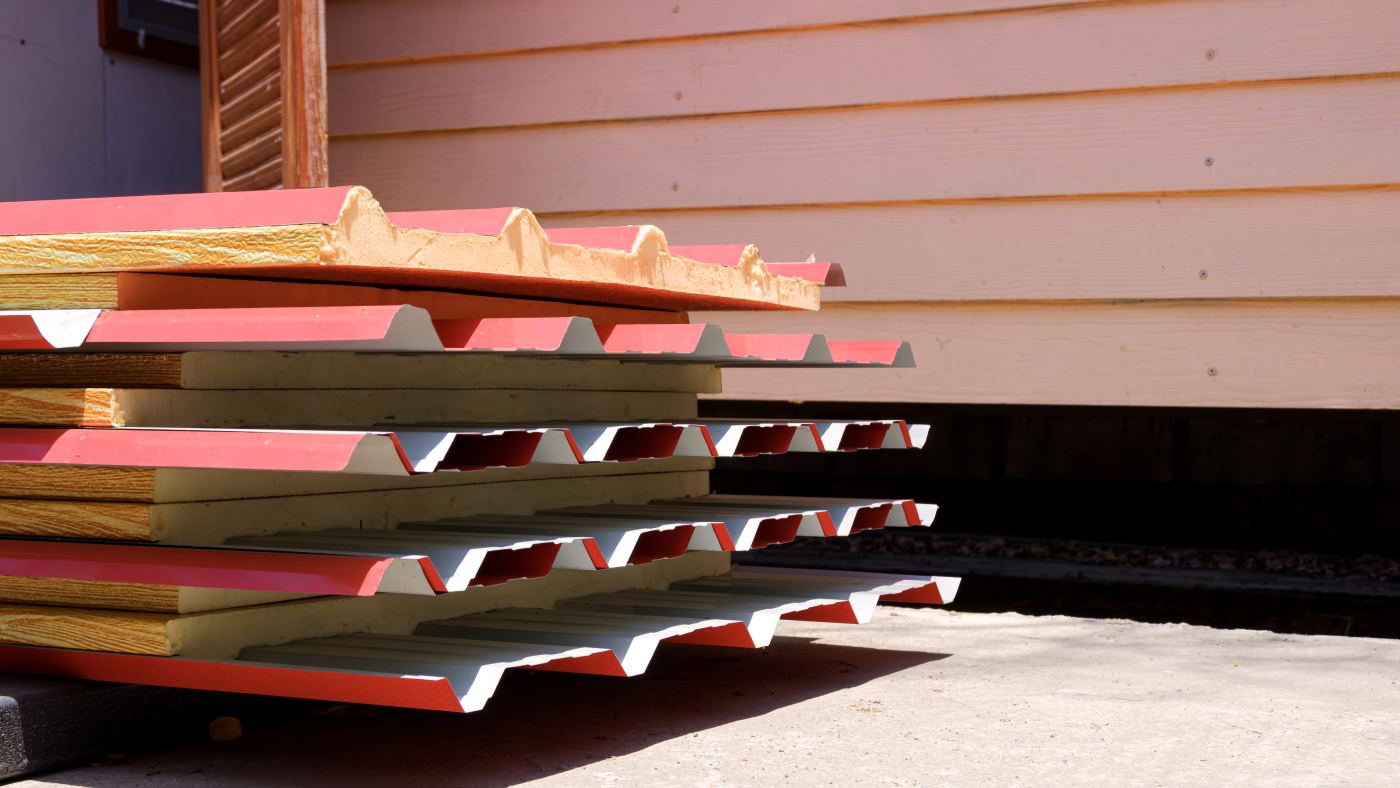
Sandwich Panels
The sandwich panel is a prefabricated composite building component designed according to the "stressed skin and core" principle. In engineering terms, this element leverages the high moment of inertia resulting from the distance between the two outer skins (typically galvanized steel or aluminum) to ensure superior flexural rigidity relative to its weight. The central core, in addition to acting as a structural spacer, serves as a thermal barrier, minimizing the thermal transmittance (U) of t...
The sandwich panel is a prefabricated composite building component designed according to the "stressed skin and core" principle. In engineering terms, this element leverages the high moment of inertia resulting from the distance between the two outer skins (typically galvanized steel or aluminum) to ensure superior flexural rigidity relative to its weight. The central core, in addition to acting as a structural spacer, serves as a thermal barrier, minimizing the thermal transmittance (U) of the entire system.
Origin and History
The structural intuition of the "sandwich" dates back to aeronautical studies in the 1930s, but its massive application in civil and industrial construction occurred post-World War II. The economic boom and the need for rapid reconstruction led, in the 1950s, to the development of continuous production lines. Technological evolution has seen the transition from early balsa or glass wool cores to modern expanded polymers (PUR/PIR) and oriented fiber mineral wools, making the sandwich panel the global standard for contemporary industrial architecture and high-efficiency dry construction systems.
Types
The choice of the panel's stratigraphy depends on the fire safety, thermal, and static performance required by the project:
- Polyurethane (PUR) and Polyisocyanurate (PIR) Core: Closed-cell polymers offering the lowest thermal conductivity available on the market. PIR panels, in particular, guarantee superior thermal stability and fire resistance (Class B-s1, d0).
- Mineral Wool Core (Stone Wool): Featuring fibers oriented orthogonally to the skins, this type is specifically for fire compartmentation (up to REI 240) and acoustic attenuation due to the material's porosity.
- Polystyrene Core (EPS): An economical and lightweight solution, primarily used where high fire resistance is not a primary requirement.
- Architectural Finishes: Versions with micro-ribbed, smooth, or hidden-joint external skins, designed for high-end facades where aesthetics merge with technical functionality.
Symbolism
- The sandwich panel is the emblem of functional integration. It symbolizes the ability of modern technology to fuse opposing physical properties, the lightness of the core and the strength of the steel, into a single solid body.
- It represents the speed of progress and resource optimization, becoming the architectural symbol of the transition toward industrialized and modular construction.
Interesting Facts
Correct installation requires meticulous attention to air and water tightness at the joints. Butyl sealants or pre-inserted gaskets are often used to prevent thermal bridges and leaks. A technical curiosity concerns "differential expansion": sandwich panels with dark-colored external skins can reach surface temperatures exceeding 80°C under solar radiation, causing bowing phenomena (bimetallic effect) that designers must compensate for through proper fixing systems and expansion joints.